When a company is early in their revenue journey, an overly structured operating rhythm can truly be detrimental to real growth.
At a sub-$20M stage, your competitive advantage is your ability to be lean, flat, and fast. You are hunting for product-market fit, and a daily standup across key functions is usually enough. At this stage, over-structuring your team can actually be detrimental to growth and you need the flexibility to react as you learn.
But if you’re doing things right, a hard truth starts to emerge, sooner than you realize: What got you to $20M will not get you to $50M, $100M, or beyond.
As you scale, the business starts to become a complex machine with specialized roles and layers of management. New dynamics are at play and suddenly your operating processes are shifting. You’re probably finding yourself spending over half your week in internal meetings, rehashing the same topics because information isn't sticking. Time is your most valuable resource, and you’re quickly stalling out.
The Strategic Necessity of an Operating Rhythm
Of all the levers a CRO can pull at this stage, prioritizing a disciplined operating rhythm will set the foundation for how your entire organization spends its time.
When done well, it provides several high-impact benefits:
Bidirectional Information Flow: It creates a reliable system for disseminating critical strategy down to the Individual Contributor (IC) level and surfacing front-line insights up to the Head of Revenue.
Goal Alignment: It ensures every team member is focused on the same objectives, preventing the "spinning" that occurs when teams row in different directions.
Executive Efficiency: As a leader, your title carries a different weight as you grow; you can no longer be in every deal or conversation. A thoughtful rhythm brings efficiency to you and your team by creating consistency in expectations and execution.
Smart Scaling: This is one of the largest areas of impact for ensuring an efficient and smart organization that can survive the transition from "startup" to "enterprise".
While it is easy to put a schedule in place, the real value comes from holding yourself accountable to the discipline of the rhythm and sticking to the specific points and purpose of every interaction.
The Cost of a “Broken” Rhythm
Conversely, a poor operating rhythm becomes taxing for company growth. It is often too time-consuming without being productive, wasting valuable hours in meetings that feel like a "rehash" because information wasn't properly understood the first time.
For employees, a lack of structure creates chaos and confusion. It leads to a feeling of being isolated and alone, as the lack of clear communication channels makes the organization hard to navigate. For the leader, it results in spending over half the week in internal meetings instead of working with prospects or coaching the team.
A successful Operating Rhythm is far more than specific meetings on a calendar; it’s about defining the purpose and flow of information.
Designing Meeting Cadence for Flow
When you're designing an operating rhythm, you need to reframe your focus to ensure that your meetings are additive, not duplicative, creating a flow of information that is both timely and relevant.
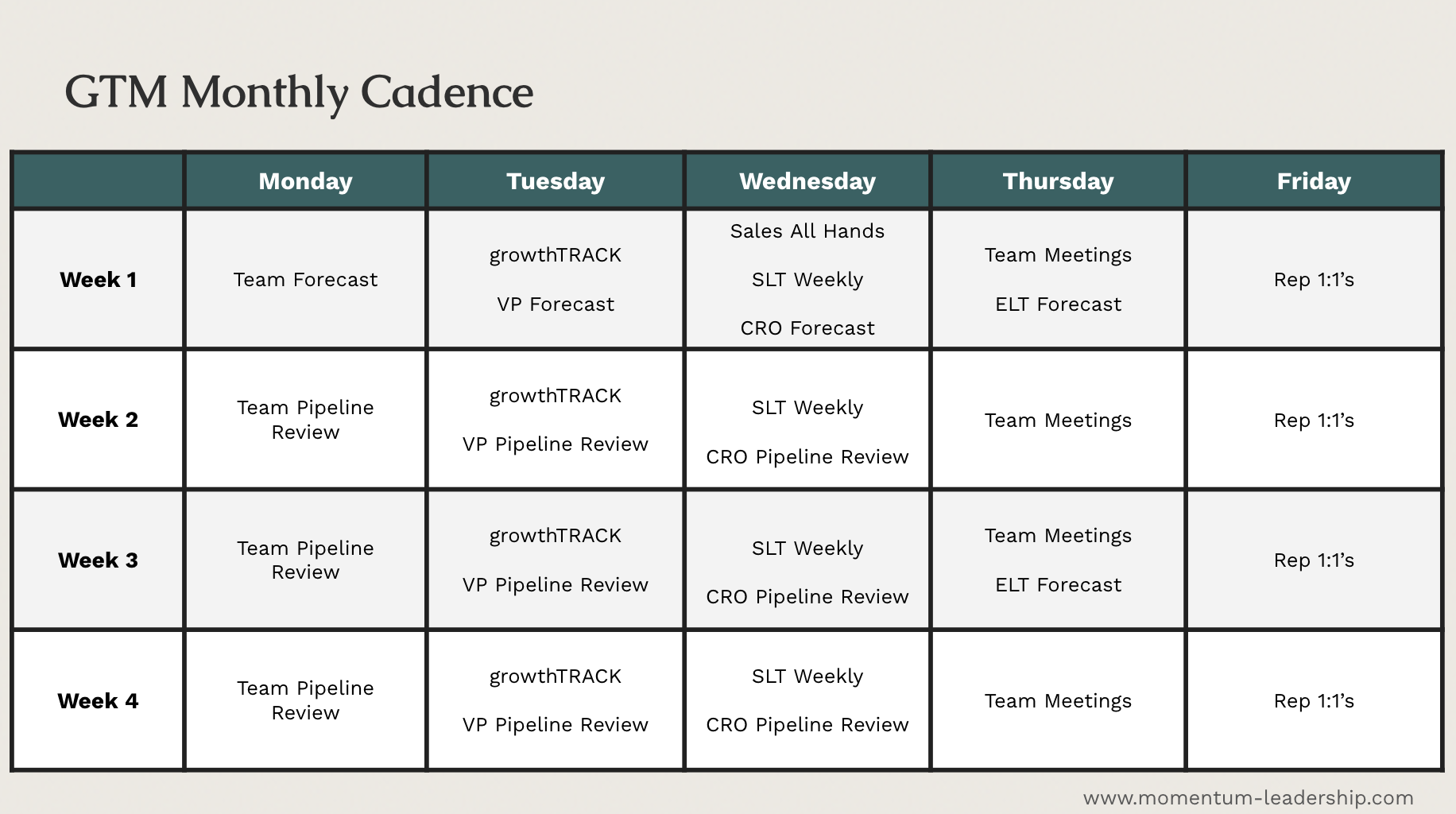
We often see CRO leaders confuse three distinct activities that are critical to their OR - Forecasting, Pipeline, and 1:1s. When these blur together, you waste time in the weeds and neglect rep development.
Here is how to separate them:
The Forecast Call (Monthly): This is not about individual deals. It is a rapid-fire environment focused on what is closing, why, and what the contingency plans are. It’s about the number, not the nitty-gritty.
The Pipeline Call (Weekly): This is the brainstorming space between manager and rep. This is where you go deep into deal strategy, identify pressure points, and determine what resources are needed to move the needle.
The 1:1 (Weekly): These 30 minutes are sacred for pure development. It is not a deal review, but rather behavior, mentality, and skill-building. If you spend this time fighting fires, you aren't growing your people.
“Pro Tip: Timing matters. Hold your Senior Leadership Team meetings before weekly team meetings. This ensures managers have the information they need to reinforce the message to their teams immediately.”
Measuring Success Beyond the Calendar
As a CRO, how will you know if your new rhythm is working? There are three main key indicators to track:
eNPS (Employee Net Promoter Score): Do your people feel knowledgeable about the company's focus? Do they feel they have the information needed to do their jobs? In an effective OR, these scores improve as confusion vanishes.
Time Efficiency: Measure the total time spent in recurring internal meetings. A precise OR should cut a three-hour forecasting slog down to a focused 30-minute session.
Accuracy: You should see a marked improvement in forecasting accuracy and deal quality as key information surfaces more reliably.
The Momentum Perspective
At Momentum, we help CROs zero in on the most essential levers for growth. Our GTM program helps you identify the hidden inefficiencies in your time and structure, turning a common scaling evolution into a developed skillset that pushes you past major revenue milestones. If your organization feels like it’s rowing in different directions, it is time to stop the spin and start scaling. Below you’ll find a link to our complete Operating Rhythm Framework to put immediately into practice for your sales team.